Edge Computing Explained: What It Is and Why It Matters in 2026

Sunil Kumar Uikey
Founder & Editor-in-Chief
Learn what edge computing is, how it works, its benefits, real-world applications, and why it is becoming essential for IoT, AI, and 5G technologies.
Introduction
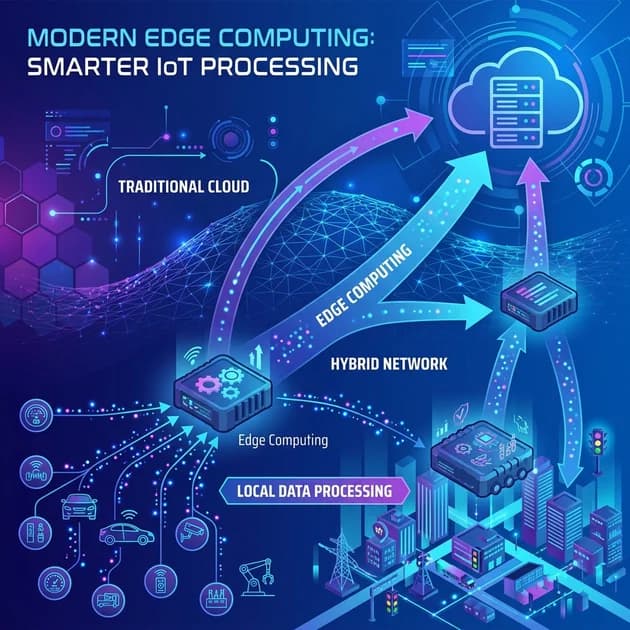
We live in an era where data is generated at an astonishing rate. From smartphones and smartwatches to autonomous cars and industrial sensors, billions of connected devices are constantly collecting information about the physical world. For the past decade, the standard technological approach has been to send all this data to massive, centralized data centers — often located thousands of miles away — for processing and storage.
But as the volume of data explodes and the need for instant, real-time responses grows, this centralized model is reaching its physical limits. Enter edge computing. By moving processing power out of distant data centers and placing it closer to where the data is actually created, edge computing is fundamentally redesigning the architecture of the internet.
Understanding edge computing is crucial because it acts as the unseen, high-speed foundation for many of the Top Technology Trends reshaping business and daily life. In this comprehensive guide, we break down what edge computing is, how its architecture functions, and why it has become an indispensable layer of our digital future.
Quick Answer
What is Edge Computing? Edge Computing is a distributed computing architecture that brings data storage and real-time processing closer to the data source (edge devices), rather than relying on a central server. By processing data locally, edge computing drastically reduces latency, saves bandwidth, and enables the real-time processing required by AI-driven applications. It acts as the critical bridge between Cloud Computing and physical devices, making autonomous digital infrastructure possible.
Edge Computing Architecture
A modern edge computing environment consists of several distinct layers working together to manage data flow.
Edge Computing Architecture Diagram
      [Devices & Sensors]
               │
               ▼
          [Edge Node]
               │
               ▼
         [Edge Gateway]
               │
               ▼
      [Micro Data Center]
               │
               ▼
        [Cloud Platform]
               │
               ▼
   [Enterprise Applications]
Edge Computing Technology Ecosystem
Edge computing does not exist in a vacuum. It is the connective tissue for a massive convergence of modern technologies:
              [IoT]
                │
                ▼
        [Edge Computing]
                │
                ▼
    [Artificial Intelligence]
                │
                ▼
          [5G Networks]
                │
                ▼
        [Cloud Computing]
                │
                ▼
         [Digital Twins]
                │
                ▼
         [Smart Cities]
Without the Internet of Things (IoT), there is no data to process. Without Edge Computing, IoT data overwhelms networks. Without Artificial Intelligence, edge data cannot be acted on autonomously. Without 5G Networks, edge devices cannot communicate rapidly. Without Cloud Computing, there is no long-term AI training. Together, these form the foundation of Digital Twins and Smart Cities.
Core Components of Edge Computing
- Edge Devices: The physical hardware that interacts with the real world (e.g., a smart security camera, an industrial robot, or a smartwatch).
- Edge Nodes: Computers with enough processing power to run basic AI models and filter data locally before it leaves the device.
- Edge Gateways: Localized servers (like an IT closet in a retail store) that aggregate data from hundreds of edge devices, translate protocols, and route traffic to the cloud.
- Edge Servers (Micro Data Centers): Small but powerful data centers located at neighborhood cell towers or internet exchange points, offering massive computing power just miles from the user.
- Cloud Integration: The centralized hyperscale data centers (like AWS, Google Cloud, or Microsoft Azure) used for massive data archiving and deep AI model training.
Modern Edge Technologies
To deploy edge architecture successfully, engineers rely on a specific stack of modern technologies supported by organizations like the Linux Foundation (LF Edge) and the Eclipse Foundation.
- Edge AI: Running machine learning algorithms directly on edge devices (like facial recognition on a smartphone) without needing an internet connection.
- Multi-access Edge Computing (MEC): A network architecture championed by ETSI that allows telecommunication companies to put edge servers directly inside 5G cell towers.
- Containers: Lightweight, portable software packages that allow developers to write an application once and deploy it across thousands of different edge devices.
- Kubernetes at the Edge: An orchestration system used to automatically manage, update, and scale millions of software containers across a highly distributed edge network.
- Microservices: Breaking down massive applications into tiny, independent pieces that can run efficiently on low-power edge hardware.
- Serverless Edge Computing: A cloud-computing execution model where cloud providers (like AWS Lambda or Cloudflare Workers) dynamically manage the allocation of machine resources at the edge, allowing developers to run code instantly worldwide.
Choosing the Right Edge Deployment (Comparison Matrix)
Enterprise architects must choose the right type of edge deployment for their specific use case.
| Deployment | Best Use Case | Primary Advantage |
|---|---|---|
| Device Edge | Cameras, Sensors | Instant "reflex" response |
| Gateway Edge | Factories, Hospitals | Local data aggregation & filtering |
| MEC (Telecom Edge) | 5G Applications | Ultra-low latency via cell towers |
| Regional Edge | Retail Networks | Fast applications, centralized locally |
| Cloud | Big Data Analytics | Massive scalability, deep learning |
How Industries Use Edge Computing (Industry Adoption Matrix)
| Industry | Primary Applications |
|---|---|
| Manufacturing | Predictive Maintenance, Industrial Automation |
| Healthcare | Remote Patient Monitoring, Robotic Surgery |
| Retail | Smart Stores, Automated Checkout, Localized Inventory |
| Transportation | Autonomous Vehicles, Fleet Telematics |
| Telecommunications | MEC Services, 5G Network Optimization |
| Energy | Smart Grid Management, Wind Turbine Optimization |
| Agriculture | Precision Farming, Drone Crop Analysis |
Best Practices for Edge Adoption
Deploying distributed infrastructure introduces significant complexity. Organizations like NIST and IEEE emphasize the following best practices:
- Security by Design: Edge devices are physically accessible to attackers. Secure boot protocols and hardware-level encryption are mandatory.
- Edge-first Architecture: Design applications to process data locally by default, only sending the absolute minimum data required to the cloud.
- Zero Trust Networking: Never assume an edge device is secure simply because it is on the company network. Require strict authentication for every data request.
- Device Lifecycle Management: Implement robust Over-The-Air (OTA) update systems to patch vulnerabilities across thousands of remote devices simultaneously.
- Local Resilience: Ensure edge gateways can operate autonomously (trigger alarms, run machinery) even if the primary internet connection goes down.
- Continuous Monitoring: Utilize AI-driven Cybersecurity tools to detect anomalous behavior on edge devices in real-time.
- Centralized Orchestration: Use tools like Kubernetes to manage the entire distributed network from a single dashboard.
- Data Governance: Maintain strict compliance by processing user data locally (e.g., in a specific country) before sending anonymized metadata to a global cloud.
- Scalability Planning: Plan network topologies that can scale from 100 edge nodes to 10,000 without requiring a complete architectural rewrite.
- Compliance: Ensure edge deployments align with strict regional data privacy laws (GDPR, CCPA) by keeping sensitive data on the device.
The Enterprise Perspective: Distributed IT
For the modern enterprise, edge computing represents a massive shift toward Distributed IT.
As companies embrace Digital Transformation, they are deploying Hybrid Cloud models that combine centralized hyperscale cloud computing with localized Intelligent Edge networks. In sectors relying heavily on Operational Technology (OT)—like manufacturing and logistics—bridging the gap between physical machinery and IT networks requires robust Edge orchestration. By shifting AI inference to the edge, companies can process real-time video analytics on the factory floor, vastly improving quality control and ensuring Business continuity even during internet outages.
Major technology companies—including Microsoft, AWS, Google Cloud, Cisco, NVIDIA, Intel, and Red Hat—are heavily investing in edge platforms to capture this enterprise market.
Future Outlook
Current Edge Landscape
We are currently in a hybrid era where edge computing is rapidly moving out of niche industrial applications (like oil rigs and factory floors) and into mainstream telecommunications through 5G MEC deployments.
Near Future (3–5 Years)
The dominant trend will be Edge AI. Instead of relying on cloud servers for AI inference, hardware accelerators (GPUs and NPUs) built directly into edge devices will allow everything from smartphones to drones to run complex AI models instantly. We will also see the rise of Federated Learning, where edge devices train AI models collaboratively without ever sharing raw user data with the cloud, vastly improving privacy.
Long-Term Outlook
Looking toward the 2030s, the integration of edge computing with emerging 6G networks and AI-enabled robotics will power fully Autonomous infrastructure. In Smart factories, production lines will self-optimize in real-time. Crucially, as the environmental cost of transmitting zettabytes of data becomes unsustainable, Sustainable edge infrastructure—processing data locally to save massive amounts of energy—will become a regulatory requirement.
FAQ Section
What is Edge AI?
Edge AI is the deployment of Artificial Intelligence algorithms directly onto physical hardware devices (like a camera, phone, or robot). This allows the device to process data and make autonomous AI decisions instantly, without needing to send data to a cloud server.
What is Multi-access Edge Computing (MEC)?
MEC is a network architecture championed by ETSI that allows telecommunication providers to place cloud computing capabilities directly inside or right next to 5G cellular towers. This provides mobile users and nearby businesses with ultra-low latency computing power.
What is the difference between Edge and Fog Computing?
They are highly similar concepts. Edge computing generally refers to processing data directly on the device or the local gateway. Fog computing (a term coined by Cisco) refers to the broader network architecture that connects the edge to the cloud, specifically the localized network connections.
Can small businesses benefit from Edge Computing?
Yes. Small businesses benefit natively when they adopt modern SaaS platforms and smart devices (like advanced retail point-of-sale systems or localized security cameras) that utilize edge processing to operate faster and maintain functionality during internet outages.
Is Edge Computing secure?
Edge computing improves data privacy by keeping sensitive data local (so it isn't intercepted on the internet). However, it introduces physical security risks, as hackers can physically access edge devices (like stealing a smart camera). It requires strict Zero Trust architecture to be secure.
Which industries gain the most value?
Industries requiring real-time physical action gain the most value: Manufacturing (predictive maintenance), Healthcare (robotic surgery, monitoring), Autonomous Vehicles (collision avoidance), and Telecommunications.
What careers are available in Edge Computing?
High-demand roles include Distributed Systems Architects, Edge AI Engineers, IoT Security Specialists, Kubernetes/Container Orchestration Engineers, and Telecommunications Network Engineers.
Final Verdict
Edge Computing is the real-time intelligence layer of modern digital infrastructure, enabling connected devices to process data close to where it is created while working seamlessly with cloud platforms for large-scale analytics and long-term intelligence.
By seamlessly combining Local Processing, Artificial Intelligence, IoT, 5G Networks, Cloud Computing, Cybersecurity, Digital Twins, and Automation, Edge Computing creates faster, more resilient, and highly scalable digital systems across industries.
To fully understand how this intelligent infrastructure is shaping the modern world, we strongly encourage you to explore the related Locitra Technology pillar articles below.
Further Reading
To explore the exact standards, engineering frameworks, and enterprise protocols driving Edge Computing, refer to the following authoritative resources:
- LF Edge (Linux Foundation): The open-source framework establishing the future of edge computing.
- Eclipse Foundation: Open-source infrastructure supporting massive IoT and edge deployments.
- ETSI MEC: The defining authority on Multi-access Edge Computing for telecommunications.
- IEEE Edge Computing: The premier professional organization advancing distributed computing engineering.
- NIST Edge Computing: The definitive US government authority on edge cybersecurity and standardization.
- AWS Edge Computing: Enterprise documentation on AWS edge architecture.
- Microsoft Azure Edge: Enterprise documentation on intelligent edge deployment.
- Google Distributed Cloud: Enterprise documentation on hybrid and edge cloud infrastructure.
Related Articles
- Top Technology Trends Shaping 2026
- What Is Cloud Computing?
- What Is the Internet of Things (IoT)? A Beginner's Guide
- What is Artificial Intelligence?
- Digital Twins Explained: What They Are and Why They Matter
- How 5G Technology Works and Its Impact
- Smart Cities Explained
- What Is Cybersecurity? A Complete Beginner's Overview
- Robotics and Automation Explained
- Industrial Automation Explained
- Autonomous Vehicles Explained
- Future of Work Technology Trends 2026
Enjoyed this article?
Get practical AI tools, technology insights, software reviews, career growth advice, and online income strategies delivered to your inbox.
Keep Reading
Related Articles
What Is Cloud Computing? A Beginner's Guide to How the Cloud Works (2026)
Learn what cloud computing is, how it works, its benefits, types, and real-world examples. A complete beginner-friendly guide for 2026.
What Is the Internet of Things (IoT)? A Beginner's Guide (2026)
Learn what the Internet of Things (IoT) is, how it works, real-world examples, benefits, challenges, and why IoT is transforming modern life.

Technology Trends in 2026: 10 Innovations Shaping the Future
Explore the definitive master guide to the top 10 technology trends shaping 2026. Discover how AI, edge computing, robotics, 5G, and sustainable innovation are converging to reshape the digital economy.

What Is Cybersecurity? A Beginner's Guide to Staying Safe Online (2026)
Learn what cybersecurity is, why it matters, common cyber threats, and practical ways to protect yourself online. A complete beginner-friendly guide for 2026.
ChatGPT vs Gemini in 2026: The Ultimate AI Showdown
An in-depth, technical comparison of ChatGPT vs Gemini in 2026. We break down their reasoning engines, ecosystem integrations, and which AI you should actually pay for.

Keeper Security Review (2026): The Enterprise-Grade Password Manager
Is Keeper the best password manager for zero-knowledge security in 2026? We review its features, pricing, and enterprise-grade encryption.